



For nearly two decades, local business visibility was a predictable game won within Google’s “Local Pack.” That era is over. We are in the midst of an epistemological shift in how consumers discover information, moving from traditional keyword searches to direct, conversational queries with AI: “Siri, find a highly-rated mechanic,” or “ChatGPT, what’s the best moving company in my area?”
In this new domain of AI-driven search, or Generative Engine Optimization (GEO), your online reviews have evolved. They are no longer just social proof for humans; they have become a primary data source that trains Large Language Models (LLMs) on how to perceive your business. Paradoxically, Yelp—a platform often viewed with ambivalence by business owners—has emerged as a cornerstone of the “Ground Truth” for local commerce. Its repository of detailed, sentiment-rich reviews directly shapes how AI systems perceive, summarize, and ultimately recommend local businesses like yours.
1. From “Ranking” to “Recommendation”: A Crash Course in AI SEO
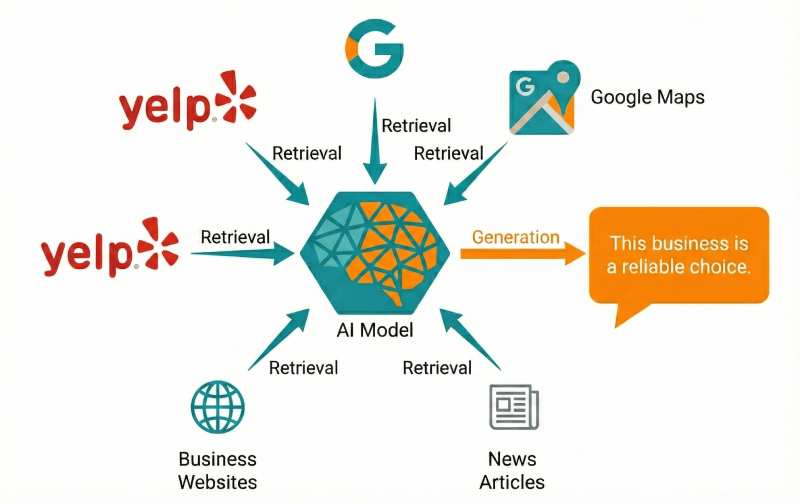
The shift from traditional Local SEO to AI-driven search represents a fundamental change in objective. You are no longer optimizing to be listed; you are optimizing to be chosen as the single best answer. This new discipline is known as Generative Engine Optimization (GEO).
Here is a simple breakdown of the old paradigm versus the new:
- Traditional SEO: The focus was on ranking in Google’s “Local Pack.” Success was driven by signals like keywords, citation consistency, and proximity. The final output was a list of links for the user to research.
- AI SEO (GEO): The focus is on being recommended by an AI. AI systems leverage retrieval-augmented generation (RAG) techniques, as seen in tools like ChatGPT, to pull and blend data from your website, reviews, and third-party listings to provide a direct, summarized answer, often sealing a decision before a single link is ever clicked.
In this environment, your business’s entire online presence—especially the text within your reviews—becomes “training data.” This data feeds the AI’s understanding of your services, quality, and trustworthiness, leading to the “direct answer phenomenon,” where consumers make decisions based on the AI’s summary alone. Your AI-generated reputation is the new first impression.
2. The Yelp Advantage: Why Detailed Reviews are “Premium Fuel” for AI
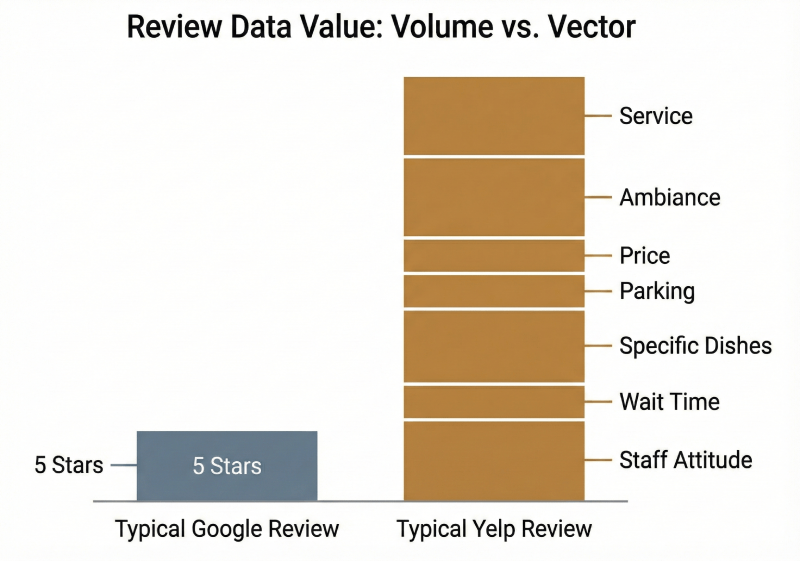
Not all review platforms are created equal in the eyes of an AI. The quality and narrative style of Yelp reviews give them a unique advantage as a data source for Large Language Models. While Google often attracts a high volume of quick ratings, Yelp’s community culture encourages longer, more descriptive feedback.
To visualize this disparity, consider the “Review Data Value: Volume vs. Vector” graph, which contrasts the breadth of coverage in typical reviews. Google reviews tend to cluster around basic star ratings with limited depth, while Yelp reviews extend into a wider array of experiential vectors—such as ambiance, parking availability, special dishes, wait times, and staff attitude—offering AI a more nuanced, multidimensional dataset for precise recommendations.
| Google Reviews | Yelp Reviews |
| Typically short, quick star ratings | Often long-form; ~60% are 3+ sentences long |
| High review collection conversion (40-60%) | Lower review collection conversion (10-20%) |
| High volume of reviews is common | Lower volume, but reviews are seen as more detailed |
| User intent is often a quick rating or brief comment | User intent is often to share a comprehensive experience |
LLMs perform sophisticated sentiment and thematic analysis, going far beyond star ratings. Yelp’s longer, narrative-driven reviews provide a much richer “Semantic Footprint.” A business with 50 detailed Yelp reviews has a more valuable footprint in an AI’s knowledge graph than a business with 200 star-only Google reviews. The AI “knows” more about the Yelp-active business and is therefore more likely to recommend it for specific, long-tail queries like “romantic Italian place with good tiramisu.” This detailed text is the premium fuel that helps an AI confidently recommend your business.
3. How the World’s Biggest AI Platforms Use Yelp Data
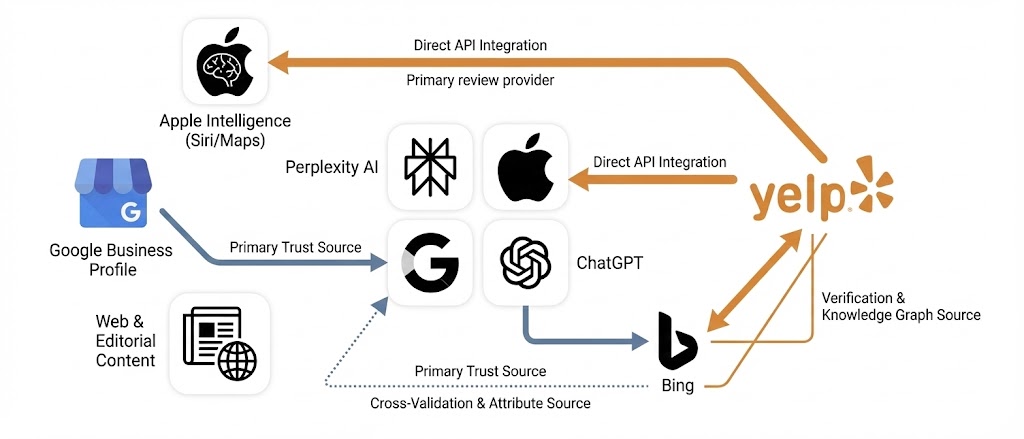
Yelp’s influence is not theoretical; it is hard-coded into the architecture of the world’s largest AI and technology platforms. Understanding these direct relationships is key to appreciating its strategic importance.
Apple (Siri & Maps): The Hardware-Level Dependency
For the massive market of iPhone users, a business’s rating in Apple Maps is its Yelp rating. Apple licenses Yelp data to power its native mapping and voice assistant services. When a user asks Siri for a recommendation, the star ratings and review photos it references are pulled directly from Yelp. Furthermore, Apple has integrated Yelp’s “Request a Quote” feature directly into the Maps interface, creating a frictionless conversion path. This direct, hardware-level dependency that affects every iPhone user justifies a maximum strategic importance score of 10/10.
Perplexity AI: The Direct API Partnership
Perplexity, a rapidly growing “answer engine,” has a formal data partnership to use the Yelp Fusion API, a commercial data pipeline that allows the search engine to bypass web scraping and access Yelp’s database directly. This allows Perplexity to pull business listings, reviews, photos, and structured attributes directly from Yelp’s database. For users of this platform, Yelp is not just a source—it is the system of record for local business information. Furthermore, Perplexity’s support for the Model Context Protocol (MCP)—an open standard for securely connecting external tools and data sources—enables AI agents like Anthropic’s Claude to access this Yelp-enriched information in real-time workflows, enhancing agentic capabilities for tasks such as dynamic local recommendations. If your business is absent or poorly represented on Yelp, it is effectively invisible on Perplexity. This direct API integration makes Yelp an indispensable data source, justifying a strategic importance score of 10/10.
ChatGPT & Bing: The Verification and Training Data Nexus
ChatGPT’s live search functionality is powered by the Microsoft Bing index. Bing has historically used Yelp as a core data source for its own “Knowledge Graph” for local businesses. More importantly, Yelp’s massive, publicly available repository of text was a significant part of the historical training data used to build foundational models like GPT. This means ChatGPT’s “world knowledge” of your business’s reputation is influenced by your long-term Yelp history. Because it serves as both a verification source and foundational training data, its strategic importance is a high 7/10.
Google Gemini: The Cross-Validation Authority
While Google’s AI ecosystem (Gemini, AI Overviews) prioritizes data from Google Business Profile, it does not operate in a vacuum. It actively uses data from trusted, authoritative third-party sites like Yelp to cross-validate information and detect inconsistencies. This creates a “Trust Gap” problem: if a business has a 4.9-star rating on Google but a 3.2 on Yelp, the AI detects a data conflict. This discrepancy reduces the AI’s confidence, making it less likely to recommend the business. Because Gemini uses Yelp primarily for validation rather than as a primary source, its strategic importance is a moderate but crucial 5/10.
Table 1: Yelp’s Strategic Importance Across AI Ecosystems
| Ecosystem | Yelp’s Role | Strategic Importance Score (out of 10) |
| Apple (Siri/Maps) | Core Provider; powers ratings and quotes. | 10 |
| Perplexity AI | Primary System of Record via API. | 10 |
| ChatGPT / Bing | Verification & Foundational Training Data. | 7 |
| Google Gemini | Validator; cross-references data to confirm trust. | 5 |
4. The Yelp Paradox: Navigating Filtering Risks and AI Trust
No discussion of Yelp is complete without addressing the primary frustration for business owners: its aggressive and opaque review filtering system. This presents both a risk and a potential hidden advantage in the AI era.
The main risk to your AI SEO is that if Yelp’s algorithm filters too many legitimate positive reviews, it can create an artificially low rating. This can trigger an “AI Warning Signal” when an LLM synthesizes conflicting data, such as a 4.8-star rating on Google versus a 3.5 on Yelp. The AI may interpret this discrepancy as a sign of manipulation and avoid recommending your business.
However, there is a powerful counter-argument: the “Clean Data Hypothesis.” Yelp uses its own sophisticated LLMs to aggressively moderate content, blocking over 23,600 inappropriate reviews in 2023 alone. While frustrating, this process results in a higher-quality, more trustworthy dataset for external AIs compared to less-moderated platforms. Because AI models are being trained to value data quality and authenticity, they may implicitly assign a higher weight to the thematic findings extracted from the remaining, heavily vetted Yelp reviews.
5. Your 5-Step Action Plan to Optimize Yelp for AI Visibility
To succeed in this new landscape, you must treat your Yelp profile not as a simple review page but as a structured data feed for machines.
- Establish Foundational Consistency Claim and fully optimize your Yelp profile. Ensure your Name, Address, and Phone (NAP) data is 100% accurate and perfectly matches your Google Business Profile and website. Audit all business attributes (e.g., “Wheelchair Accessible,” “Offers Delivery,” “Good for Kids”) and fill them out completely. AIs rely on this structured data for specific, multi-variable queries.
- Cultivate Thematic, Narrative Reviews When asking for feedback, guide customers to leave detailed, descriptive reviews. Instead of just asking for a rating, prompt them with questions that encourage narrative. For example, a moving company could ask, “We’d love to hear your feedback on Yelp about your experience with our packing services and the care our team took with your belongings.” This generates the keyword-rich, thematic content that AI models use to build compelling summaries.
- Master the Response as Data Injection Your public responses to reviews are indexed and analyzed by AI. Use them to add valuable context, keywords, and positive framing. Respond professionally to all reviews, positive and negative.
- Generic Response: “Thanks for the review!”
- Optimized Response: “Thank you for your feedback! We’re proud that our crew of professional movers in Austin could make your cross-town move a smooth experience. We appreciate you choosing us for your relocation needs.”
- The optimized response injects valuable entities (“professional movers,” “Austin,” “cross-town move,” “relocation”) that an AI can associate with your business through thematic clustering.
- Reinforce Reputation on Your Own Turf Don’t let your best reviews live only on Yelp. Embed positive Yelp reviews and testimonials directly on your business website, especially on service or location pages. Use
AggregateRatingandReviewschema markup to make this social proof machine-readable. This tells search engines and AI models that you stand by the feedback you receive. - Develop a Visual SEO Strategy Upload high-resolution, well-lit photos of your business, services, and team to your Yelp profile. Crucially, add descriptive captions. These photos directly feed into Apple Maps and are used by visual search tools like Google Lens. A caption like “Our private dining room, perfect for groups of up to 20” provides a text anchor that helps visual AI understand and categorize the image.
Yelp is a Data Feed, Not Just a Review Site
In the age of AI, your Yelp profile has evolved. It is no longer just a platform for customer feedback; it is a critical, structured data feed that AIs use to validate your existence, understand the nuances of your customer experience, and build trust. While Google Business Profile remains the foundation for local visibility, Yelp provides the qualitative, descriptive content necessary for a compelling AI recommendation.
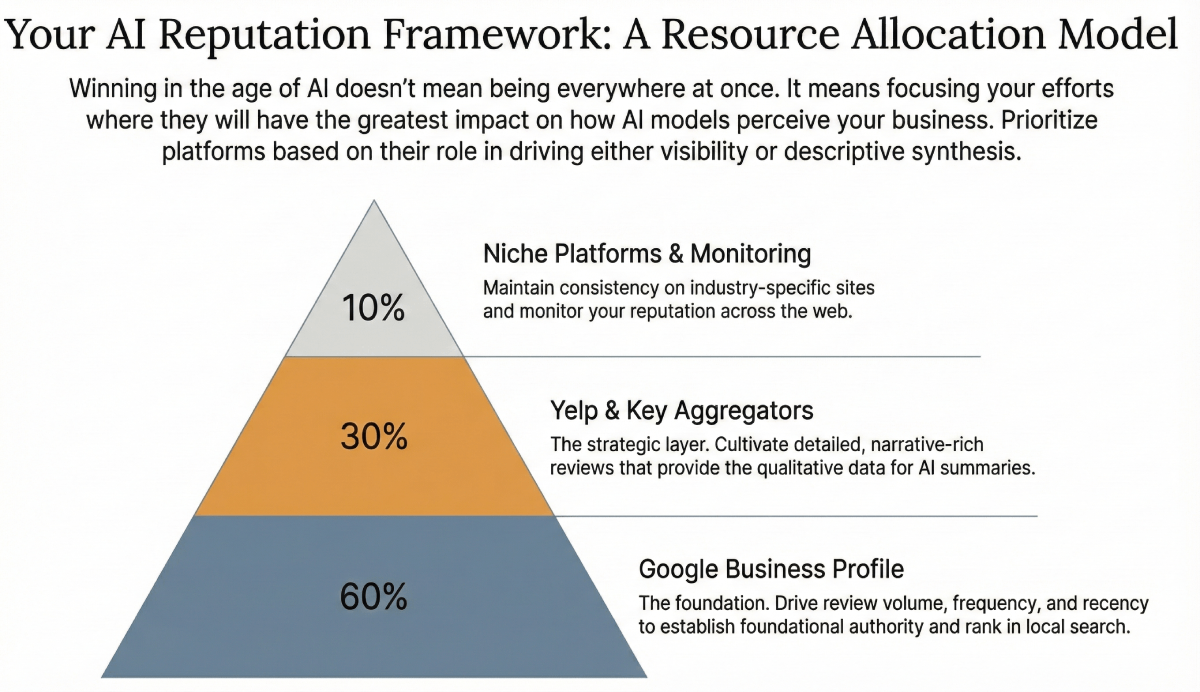
Neglecting your Yelp reputation creates a “trust gap”—a data discrepancy that AI is programmed to avoid. This is a zero-sum game; there is often only one AI-recommended answer, not ten blue links. Proactive management is no longer optional; it is a competitive necessity for any modern local marketing strategy designed to win in the new era of generative search.


