



The Local Entity Model (LEM)
For years, Local SEO has been framed as a game of rankings: optimize the page, complete the profile, collect the reviews, win the map pack.
That mental model no longer explains what we’re seeing.
- Businesses with “worse SEO” outrank better ones.
- Highly optimized listings fail to appear in AI answers.
- Some companies remain visible but are quietly excluded from recommendations.
What’s happening is not random — it’s structural.
By 2026, local search is no longer governed by ranking factors alone. It’s governed by how well AI systems can model a real business as a coherent, trustworthy entity operating in the real world.
This shift is best understood through what we’ll call the Local Entity Model (LEM).
What Is the Local Entity Model (LEM)?
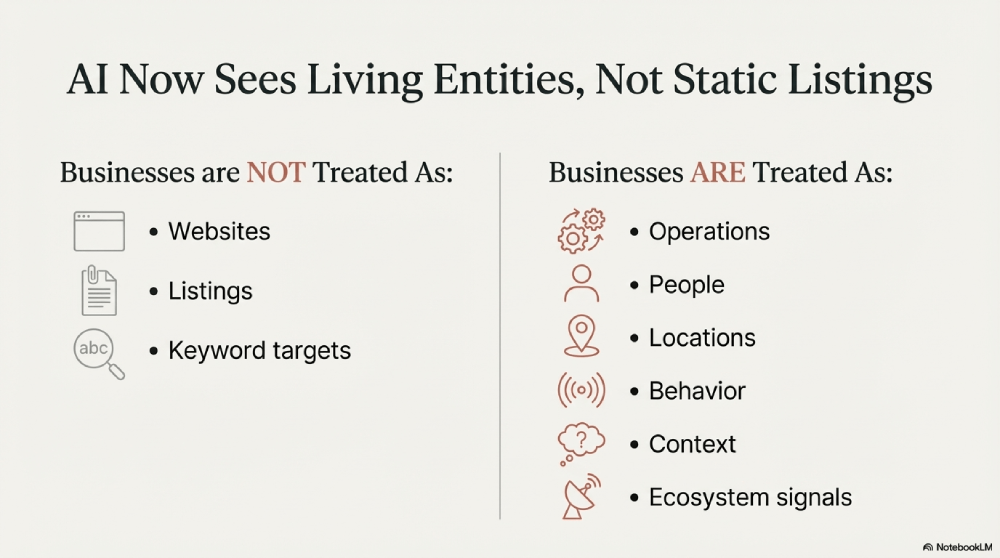
Infographic titled ‘AI Now Sees Living Entities, Not Static Listings’ comparing traditional SEO targets like websites to modern entity signals like operations, people, and behavior
The Local Entity Model describes how AI-driven search systems understand, evaluate, and recommend local businesses.
Under LEM, businesses are not treated as:
-
Websites
-
Listings
-
Keyword targets
They are treated as living entities composed of:
-
Operations
-
People
-
Locations
-
Behavior
-
Context
-
Ecosystem signals
AI doesn’t ask, “Which page is best optimized?”
It asks, “Which real-world entity best fits this user, here and now?”
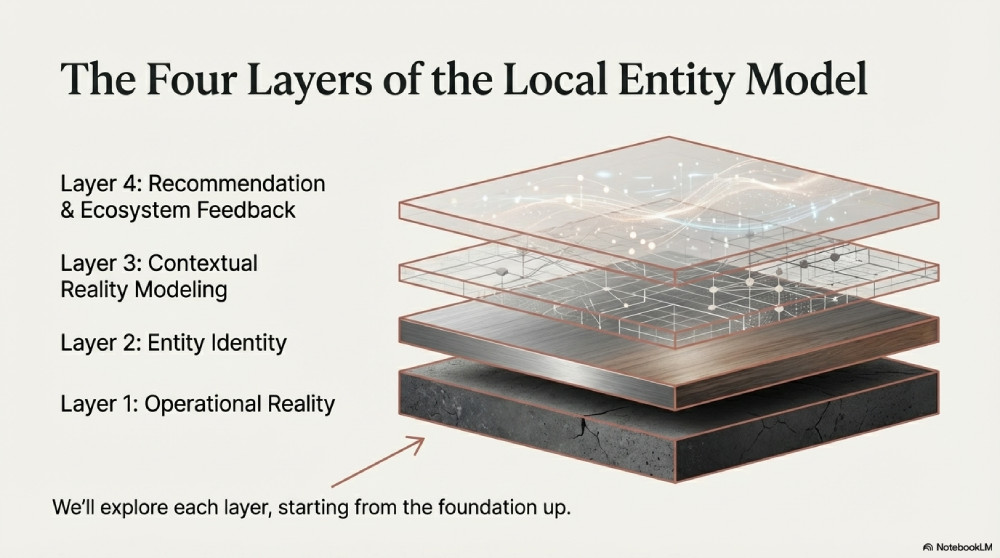
A 3D stack diagram showing the four layers of the Local Entity Model: Operational Reality, Entity Identity, Contextual Reality Modeling, and Recommendation & Ecosystem Feedback
LEM explains why visibility, rankings, AI answers, and recommendations increasingly diverge — and why traditional Local SEO advice feels less reliable each year.
Layer 1: Operational Reality
When AI Starts Ranking Availability, Not Businesses
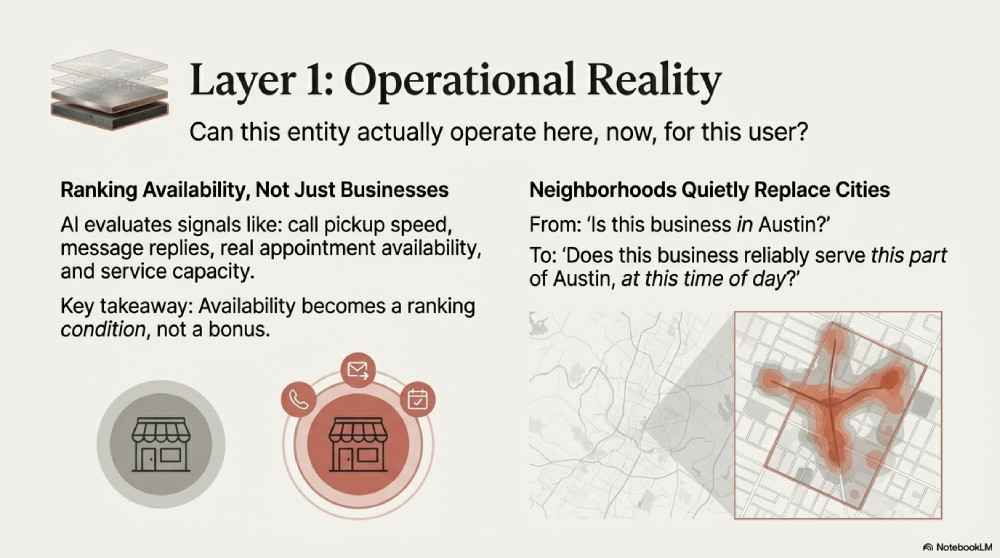
Infographic for ‘Layer 1: Operational Reality’ explaining how AI ranks businesses based on real-time availability and granular neighborhood service patterns rather than broad city-wide data
The first layer of LEM is operational reality.
AI increasingly evaluates whether a business can actually serve a user in a specific moment and place.
This includes signals such as:
-
Call pickup and response speed
-
Message replies
-
Real appointment availability
-
Staffing and service capacity
-
Whether demand is being absorbed or deflected
Two businesses with identical listings and similar reviews will not rank equally if only one of them can realistically handle new customers.
Availability becomes a ranking condition, not a bonus.
Local search starts behaving less like a directory and more like a real-time matching system.
Neighborhoods Quietly Replace Cities
At the same time, geographic relevance is becoming more granular.
Cities are too broad.
ZIP codes are administrative artifacts.
AI increasingly relies on:
-
Neighborhood patterns
-
Drive-time behavior
-
Repeat visit clustering
-
Real movement data
The question shifts from:
“Is this business in Austin?”
to
“Does this business reliably serve this part of Austin, at this time of day?”
As a result, city-wide optimization becomes less predictive. Behavioral coverage matters more than keyword geography.
Layer 2: Entity Identity
Why the Website Still Matters — But Only If It Reflects Reality
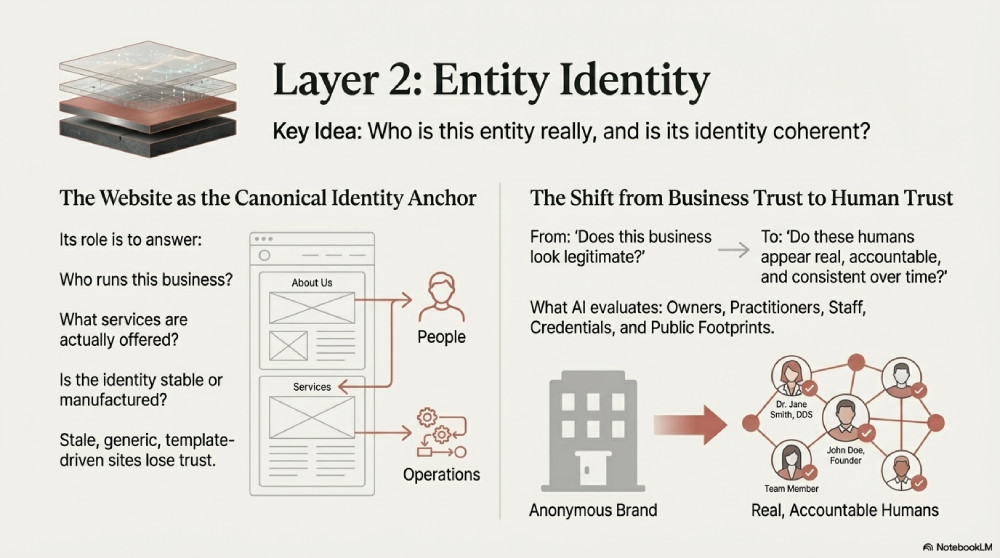
Infographic for ‘Layer 2: Entity Identity’ highlighting the website as a canonical identity anchor and the shift from anonymous brand trust to trust in real, accountable humans like owners and staff.
The website does not go away in 2026 — but its role changes.
Under LEM, the website functions as the canonical identity anchor for the entity.
AI uses it to answer questions like:
-
Who runs this business?
-
What services are actually offered?
-
How long has this operation existed?
-
Is the identity stable or manufactured?
Websites that are:
-
Generic
-
Stale
-
Template-driven
-
Disconnected from real people and operations
…quietly lose trust, even if they are technically “optimized.”
A well-maintained website that reflects real timelines, real staff, real evolution, and real-world alignment becomes stronger — not weaker — in the AI era.
From Business Trust to Human Trust
The deeper shift is this: AI increasingly trusts people more than brands.
For local services, especially in regulated or high-trust industries (medical, legal, wellness, trades), AI evaluates:
-
Owners
-
Practitioners
-
Staff
-
Credentials
-
Public footprints
-
Consistency across platforms
The question is no longer:
“Does this business look legitimate?”
It becomes:
“Do these humans appear real, accountable, and consistent over time?”
Local SEO quietly expands into human entity validation.
Layer 3: Contextual Reality Modeling
How AI Builds a Parallel Version of the Local World
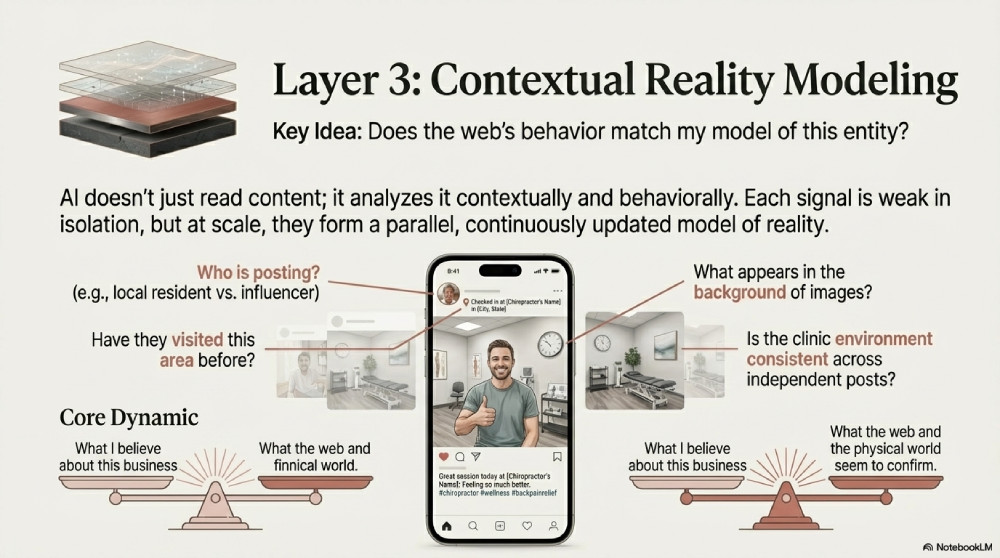
Infographic for ‘Layer 3: Contextual Reality Modeling’ showing how AI analyzes social media posts, image backgrounds, and user behavior to verify if the physical world confirms the digital model of a business entity
This is where LEM departs most radically from traditional SEO thinking.
AI no longer interprets social media, content, and mentions at face value. It analyzes them contextually and behaviorally.
When someone posts about a local business, AI doesn’t just read the caption. It evaluates:
-
Who is posting (influencer, professional, hobbyist, local resident)
-
Posting history and credibility
-
Location consistency over time
-
What appears in the background of images
-
Whether the setting aligns with the business environment
-
Whether similar posts exist from unrelated accounts
A post about a chiropractor, for example, is assessed not as “a mention,” but as a probabilistic truth fragment:
-
Is this a local person?
-
Have they visited this area before?
-
Is the clinic environment consistent across independent posts?
-
Does behavior match claimed experience?
Each signal is weak in isolation.
At scale, they form a parallel, continuously updated model of reality.
AI constantly compares:
“What I believe about this business”
vs
“What the web and the physical world seem to confirm.”
Recommendation favors entities where those two converge.
Layer 4: Recommendation & Ecosystem Feedback
From “Best Overall” to “Best for This User”
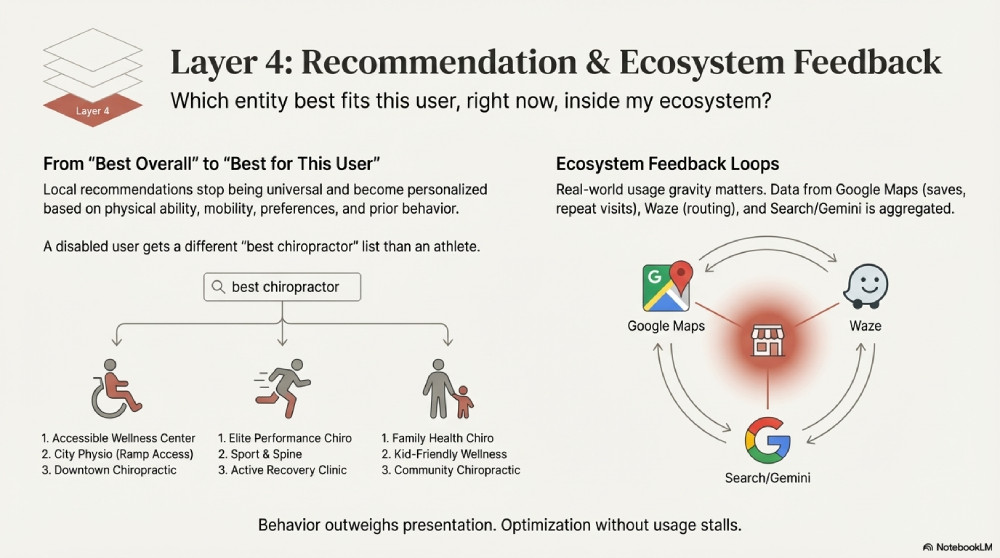
Infographic for ‘Layer 4: Recommendation & Ecosystem Feedback’ showing how local results shift from ‘Best Overall’ to personalized recommendations based on user needs and real-world usage gravity from Google Maps, Waze, and Gemini
By 2026, local recommendations stop being universal.
AI increasingly personalizes results based on:
-
Physical ability
-
Mobility
-
Sensory needs
-
Preferences
-
Prior behavior
-
Historical choices
A disabled user does not receive the same “best chiropractor” list as an athlete or a parent — even if they search the same phrase.
AI retains structured memory of:
-
Accessibility-friendly businesses
-
Specialized accommodations
-
User-specific constraints
There is no longer a single ranking — only contextual recommendations.
Ecosystem Feedback Loops (Maps → Gemini → Search)
This personalization is reinforced by ecosystem-level data.
Within Google’s ecosystem in particular:
-
Google Maps captures saves, repeat visits, dwell time
-
Waze captures routing and physical demand
-
Search and Gemini aggregate and extrapolate this data
Businesses that demonstrate real-world usage gravity — repeated visits, saves, routes, and patterns — gain recommendation priority even without aggressive optimization.
Optimization without usage stalls.
Behavior outweighs presentation.
What LEM Changes — Strategically
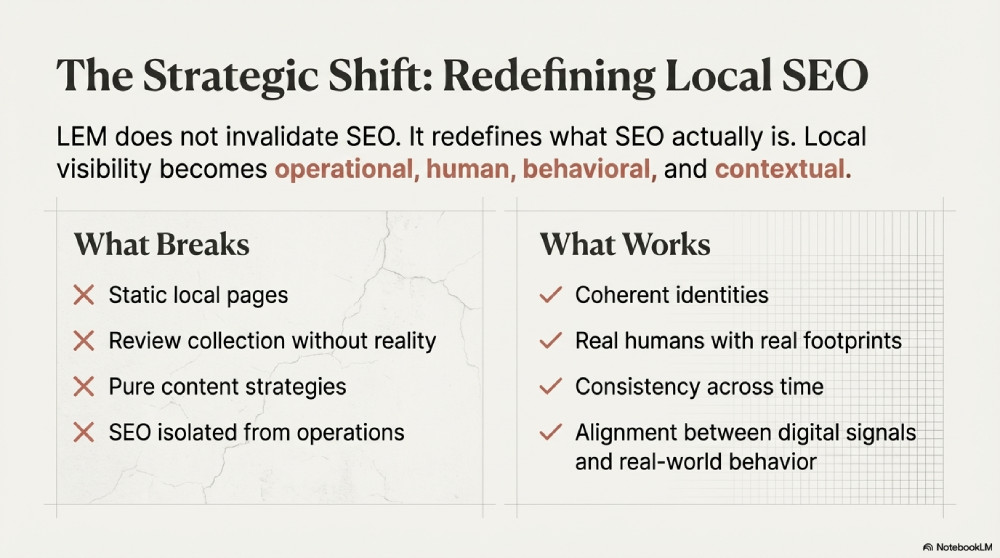
A conceptual diagram of the ‘LEM Reality’ summarizing how AI models businesses as real-world entities by comparing digital signals against physical behavior to recommend the most contextually useful result
LEM does not invalidate SEO.
It redefines what SEO actually is.
Local visibility becomes:
-
Operational
-
Human
-
Behavioral
-
Contextual
What breaks:
-
Static local pages
-
Review collection without reality
-
Pure content strategies
-
SEO isolated from operations
What works:
-
Coherent identities
-
Real humans with real footprints
-
Consistency across time
-
Alignment between digital signals and real-world behavior
The LEM Reality
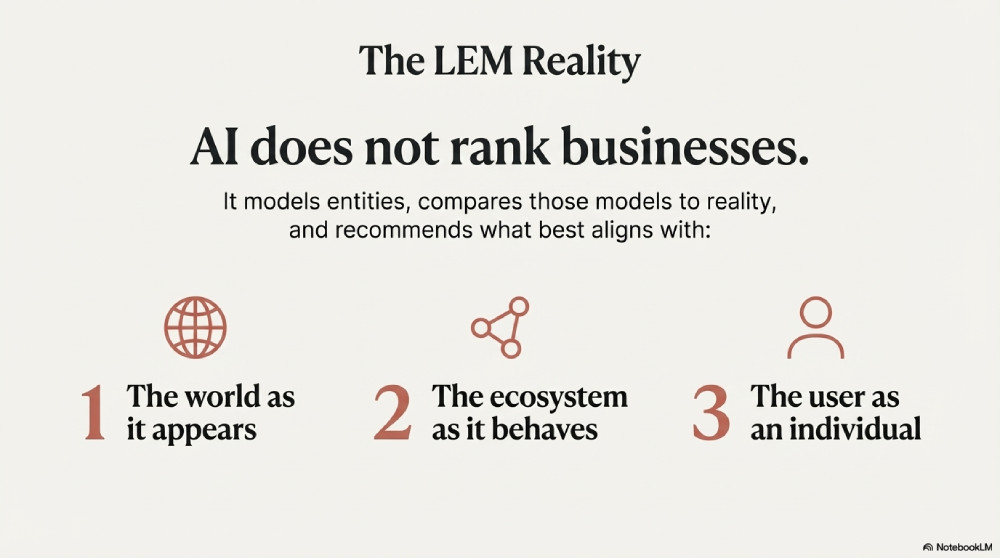
infographic titled ‘The LEM Reality’ summarizing that AI does not just rank businesses, but models them as real entities to recommend results that best align with physical-world behavior and individual user needs
AI does not rank businesses.
It models entities, compares those models to reality, and recommends what best aligns with:
-
The world as it appears
-
The ecosystem as it behaves
-
The user as an individual
In 2026, the winners of local search will not be the most optimized.
They will be the most real, coherent, and contextually useful entities in the system.
That is the Local Entity Model.


